
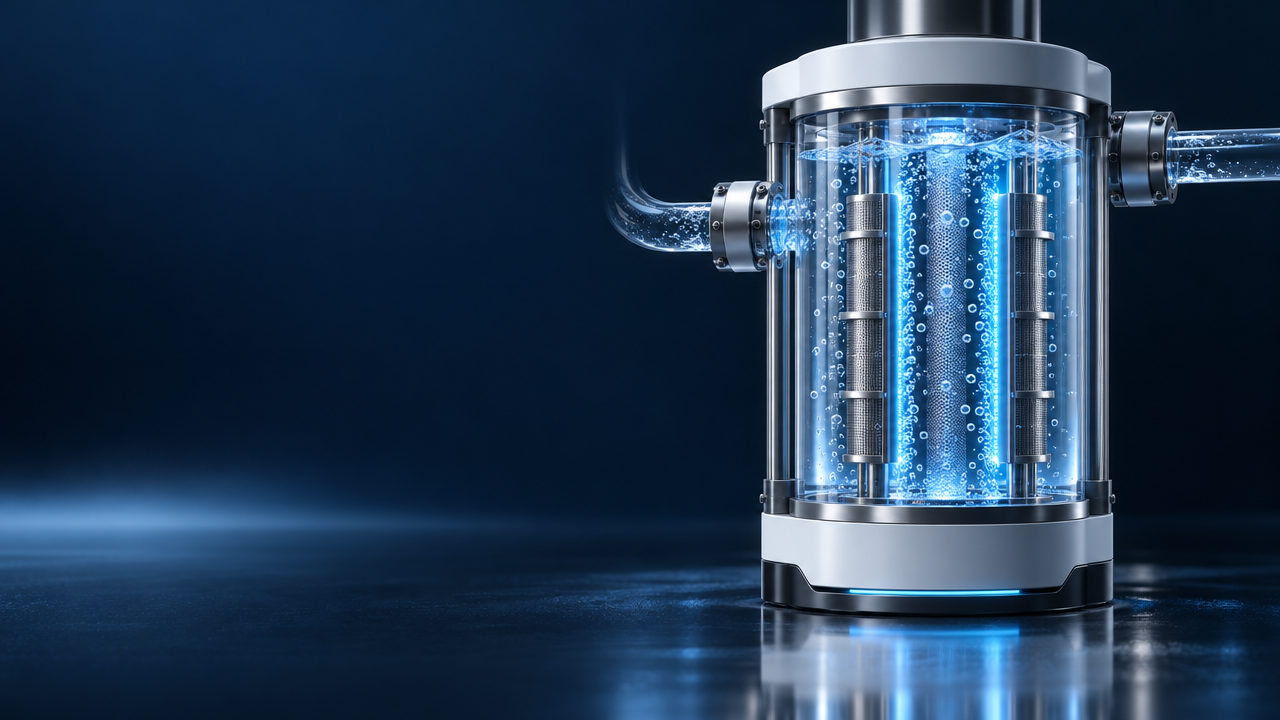
Electrolysis Water Purification
Clean water powered by electricity, not additives. Electrolysis water purification uses a low electric current to pull contaminants out of the water, while the minerals stay in.
Every Acuario system runs on Atlix, our electrolysis and electrocoagulation process. Here is how it works, and what independent research has measured.
Two processes, working as a team
Electrolysis changes the contaminants. Electrocoagulation gathers them up so the filters can catch them.
Electrolysis
A controlled, low-voltage current passes through the water inside a sealed cell. It changes the electrical charge of dissolved contaminants and breaks complex compounds into parts that can be removed. The reactive oxygen it produces kills bacteria, with no chlorine dosing.
Electrocoagulation
Once their charge is neutralized, metals, sediment, bacteria and organic compounds stop repelling each other and clump together into larger particles, called floc. What was dissolved and invisible becomes something a filter can catch.
Four steps, no chemicals added
- 1
Pre-filter
A sediment filter takes out sand, rust and visible particles before treatment.
- 2
Charge the water
Low-voltage current flows through the electrode cell. No moving parts, very little electricity.
- 3
Bind and filter
Contaminants clump into floc, and a second sediment filter captures it.
- 4
Polish
A carbon block removes chlorine taste and odor, including any made during treatment.
It removes what harms, and keeps what belongs
Most contaminants carry a negative charge and are pulled out of the water. Mineral salts such as calcium, magnesium and potassium are positively charged and stay in solution.
That is the opposite of reverse osmosis, which strips nearly everything out and sends part of the water down the drain. Acuario systems add nothing and remineralize nothing: they keep what was already there.
- Bacteria
- Heavy metals
- Organic and industrial compounds
- Sediment and particles
- Chlorine taste and odor
- Calcium
- Magnesium
- Potassium
- Your water pressure
Published in the Journal of the American Water Works Association
The electrocoagulation process behind Atlix was documented in a peer-reviewed paper in June 2000, with samples analyzed by independent laboratories. These are selected results.
The same paper also reports heterotrophic bacteria reduced from 60,000 to under 500 cfu/mL, lower turbidity, phosphates and suspended solids, and crude oil removed from seawater.
Source: Mills, D. (2000). A new process for electrocoagulation. Journal AWWA, 92(6), 34–43.
Electrolysis, reverse osmosis and UV
| Acuario electrolysis | Reverse osmosis | UV system | |
|---|---|---|---|
| How it works | Current binds contaminants, filters remove them | Pressure through a membrane | Light inactivates microbes |
| Bacteria | Removed | Removed | Inactivated |
| Heavy metals | Reduced | Reduced | Not treated |
| Chlorine taste and odor | Removed | Removed | Not treated |
| Minerals | Kept | Stripped out | Kept |
| Wastewater | None | Yes, a reject stream | None |
| Chemicals added | None | None | None |
| Whole-home flow | Yes | Usually one tap | Yes |
| Maintenance | Cell clean and filters, every 8–12 months | Membrane and filter changes | Lamp and sleeve changes |
Watch how Acuario works
Electrolysis water purification, answered
Does it remove the minerals from my water?
No. Contaminants are pulled out, while positively charged minerals such as calcium, magnesium and potassium stay in solution.
Does it waste water like reverse osmosis?
No. There is no reject stream. What the cell pulls out is captured by the filters, so all the water that goes in comes out treated.
Does it remove viruses?
Virus removal is not claimed. The documented results cover bacteria, heavy metals and organic compounds.
How much maintenance does it need?
Clean the electrolysis cell and change the filters every 8–12 months, depending on your water and how much you use.
Interested in Acuario for your home?
Tell us about your water and we'll recommend the right system. No pressure, no obligation. We serve all of Mexico.